Flora Detail
| Common Name | Wagon Tree, Waboom (afr.) |
| Family | Proteaceae |
| Date Observed | 18-09-2022 |
| Category | Bushes |
|---|---|
| Catalogue No. | 4422RG |
| Flowering Time | Autumn,Winter |
| Colour | White to Grey |
| Locations Observed | |
| Estuary | Few |
| Koppie | Not Observed |
| Nature Reserve | Not Observed |
| Small Holding | Many |
| Village | Not Observed |
| Greater Rooiels | Many |
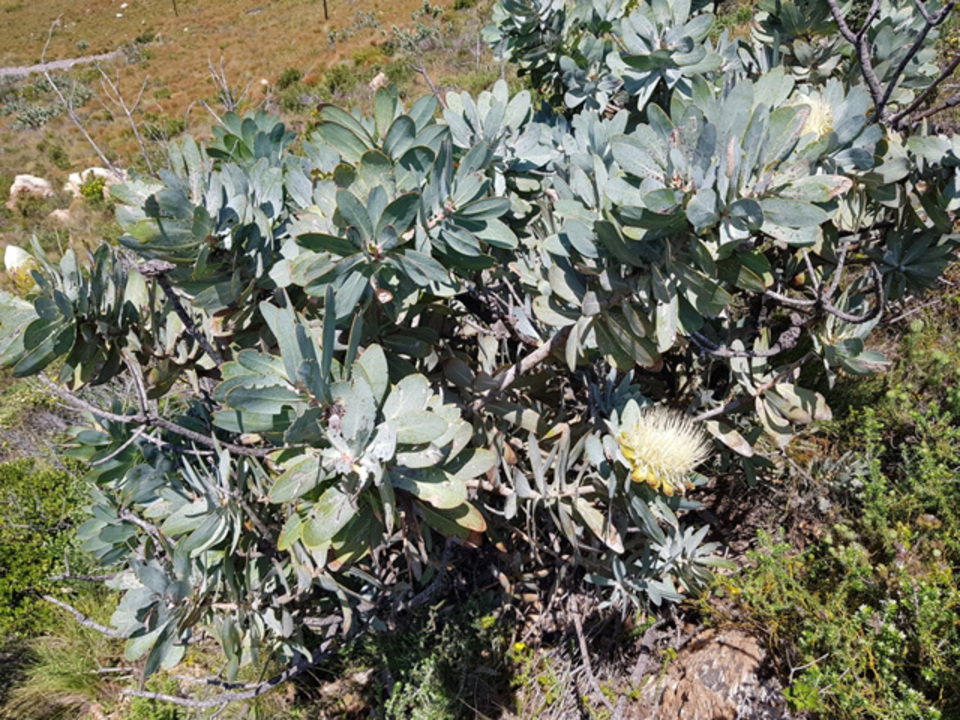
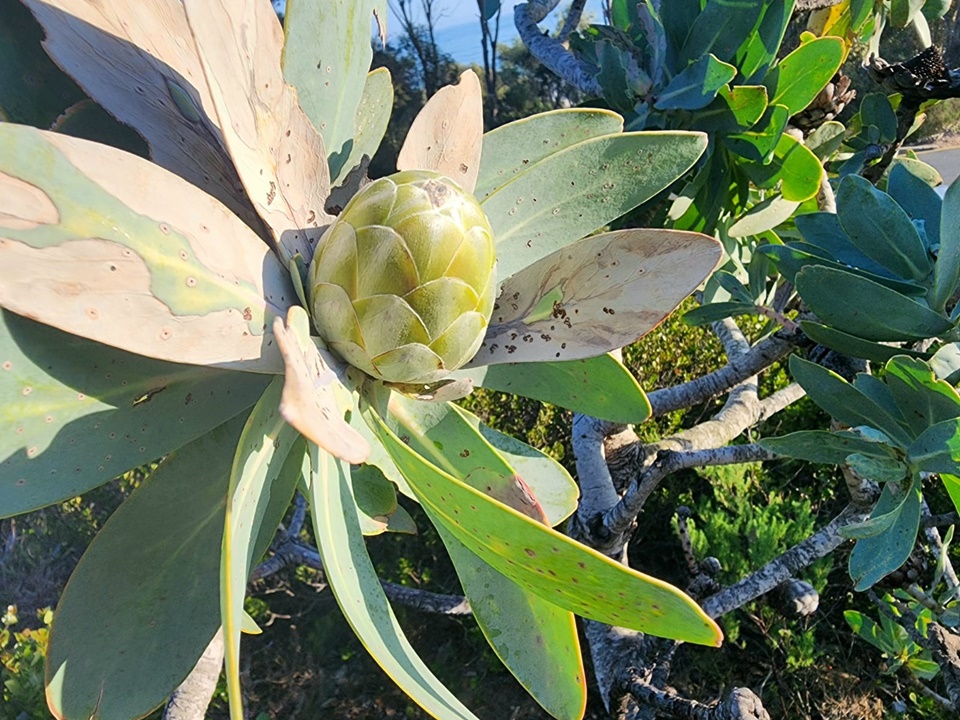
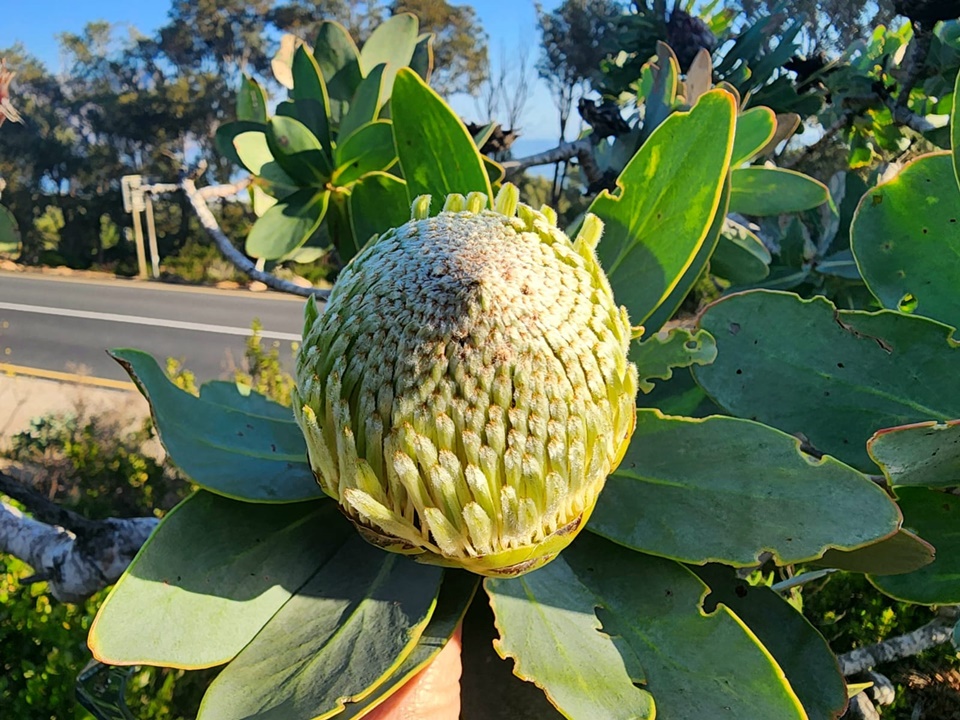
Protea nitida
Information
Wagon Tree, Waboom (Afr)

INTRODUCTION
The wood of Protea
nitida was used in the old days to make wheel rims and brake blocks for
wagons, earning it the name waboom, or wagon tree. Today, we simply
enjoy the beauty of its blue-silver leaves.
From autumn to spring, the
flowers brighten our drives along Clarence Drive. Hiking on the mountain slopes
above Rooiels, we always stop to take photographs of the large, greenish-white
flower heads.
DISTRIBUTION & HABITAT
Protea nitida has a widespread distribution, ranging from the Bokkeveld Escarpment
and Cape Peninsula to the Winterhoek Mountains in the Eastern Cape. It occurs
from sea level to about 1,200 m above sea level.
Locally, you can see it all
the way from Gordon's Bay to Kleinmond, growing on the mountain slopes on both
sides of the road.
ECOLOGY & FIRE SURVIVAL
The trunks of mature trees
are protected by a thick layer of bark, helping them survive fynbos fires.
Younger trees may be killed
by fire but can resprout from an underground bole. The seeds remain stored in
the flower heads until they are dry, when the heads release them and the seeds
are dispersed by the wind.
When photographing these
flowers, one is enchanted by the many insects visiting them—and the birds, of
course.
SIGNS OF LEOPARDS
When passing a waboom, take
a close look at its trunk. You might find scratch marks left by a
leopard—rather like a domestic cat scratching against a scratching post.
TRADITIONAL USES
Protea nitida is unusual among proteas in having wood suitable for making furniture.
Its wood also made excellent charcoal, which gave rise to the Afrikaans name brandhout.
The bark was used for
tanning leather, while the leaves were used to make ink. They were also used to
prepare a tea traditionally believed to help with various ailments.
CONSERVATION STATUS
In the past, Protea
nitida was heavily harvested for its useful wood, bark and leaves. About
20,000 trees were chopped down annually by the latter part of the 19th century
for traditional use.
(SASOL Proteas – A Field Guide to the Proteas of Southern Africa.)
Fortunately, we no longer
depend on the waboom for these traditional uses, and its conservation status is
Least Concern.
Today, the value of Protea
nitida lies in its magnificent presence on the mountain slopes and along
the R44 as it winds along the Kogelberg.