Flora Detail
| Common Name | Long-leaf sugarbush, Swartbaardsuikerbos (Afr.) |
| Family | Proteaceae (Protea Family) |
| Date Observed | 21-07-2026 |
| Category | Bushes |
|---|---|
| Catalogue No. | 4451RGu |
| Flowering Time | Spring,Winter |
| Colour | White to Grey |
| Locations Observed | |
| Estuary | |
| Koppie | |
| Nature Reserve | |
| Small Holding | Few |
| Village | |
| Greater Rooiels | |
Protea Longifolia
Information
Long-leaf sugarbush, Swartbaard (Afr.)

PROTEA LONGIFOLIA (Longleaf Protea. Afr. Swartbaardprotea)
INTRODUCTION
Protea longifolia (Longleaf Protea) is sparsely distributed, and you won't find it
growing in dense stands. We were therefore particularly excited to discover
three young, healthy plants on the smallholdings.
DESCRIPTION
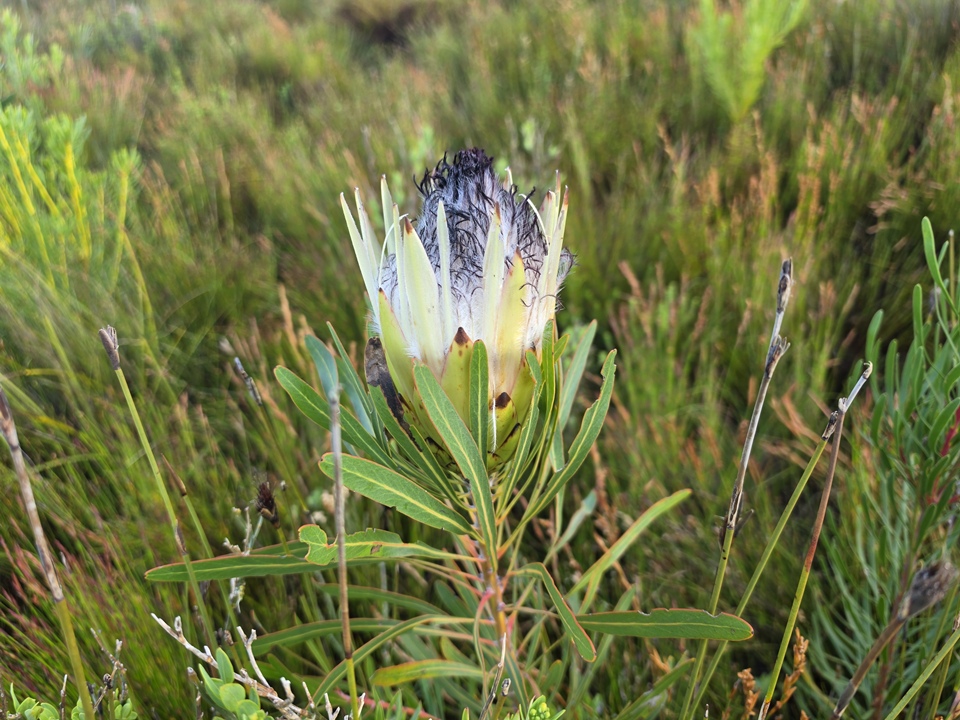
Protea longifolia occurs in shades of yellow-green, creamy white and light pink. We have
only seen the creamy-white form in Rooiels.
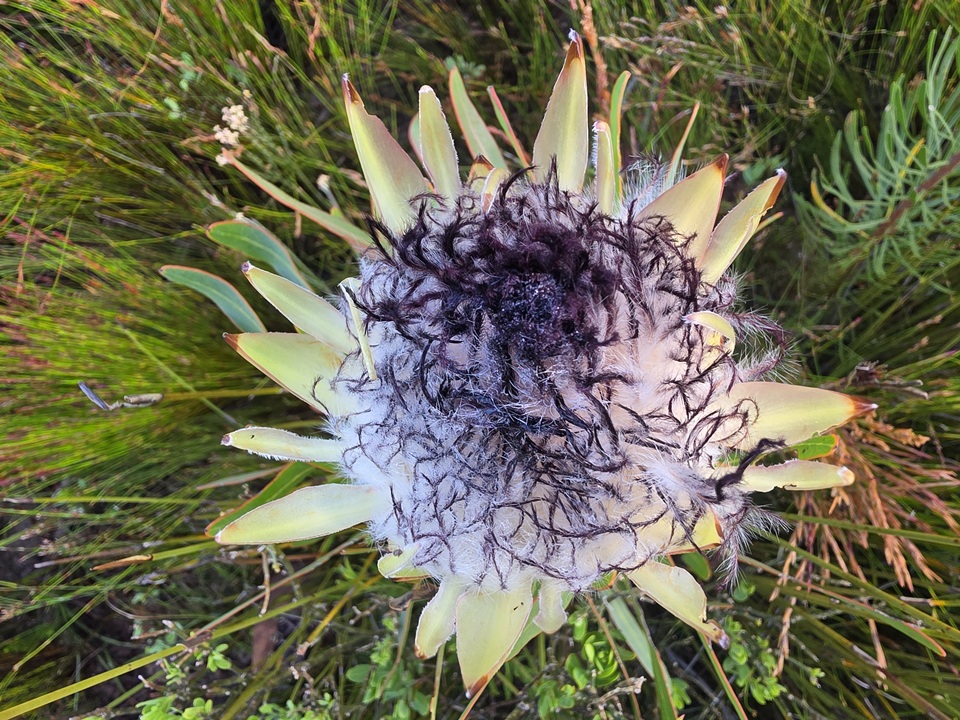
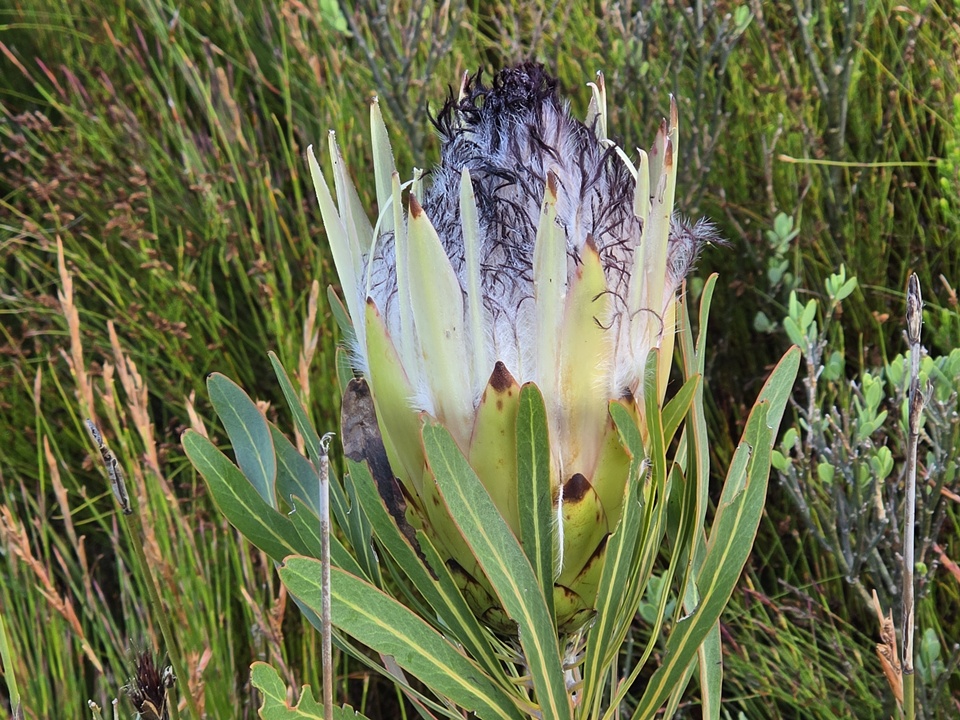
It is easily recognised by
the distinctive black-bearded tips that protrude from the flower heads. The
long leaves are sometimes slightly twisted and point upwards, helping to reduce
water loss.
Protea longifolia produces masses of flowers from mid-winter through spring.
DISTRIBUTION & HABITAT
Protea longifolia grows naturally on gravel flats and in sandy soils on lower slopes,
from Du Toit's Kloof to Riviersonderend and Bredasdorp Mountain, and on the
Elim Flats.
We have observed it in the
Kogelberg Mountains and on Jean's Hill in Kleinmond. In Rooiels, we were
delighted to find three shrubs on the smallholdings.
ECOLOGY & FIRE
Most proteas are pollinated
by nectar-feeding birds, particularly sunbirds and sugarbirds.
Protea longifolia does not resprout after fire. When the plant dies or is killed by fire,
its seed heads open and release masses of seeds. These provide food for rodents
and birds, while the remaining seeds are held in place by a soft coat of hairs,
helping them remain in the soil until conditions are suitable for germination
after rain.
USES
Protea longifolia makes a magnificent garden shrub, although it is not considered a good
cut flower.
It is known as a
“promiscuous” protea because it readily forms natural hybrids with neighbouring
Protea species. Some of these hybrids are used in the cut-flower
industry, and strong plants are available from nurseries.
CONSERVATION STATUS
Protea longifolia is a range-restricted species, occurring at more than 10 stands. It is declining across its range due to ongoing habitat loss from commercial protea cultivation, as well as degradation caused by fire and invasive alien plants. According to the Red List of South African plants (2020/06/03), Protea longifolia is assessed as Near Threatened, and is on the threshold of becoming Vulnerable.